
Rise is a trading card game created by François von Orelli. Each player controls two Summoners, builds a 50-card deck and battles their opponents on the Battlefield. This page gathers everything you need to learn the game — the official documents can be downloaded at the bottom of the page.
Goal of the game
Keep at least one Summoner alive. If both of your Summoners die, you lose.
Setting up
Each player brings a deck of exactly 50 cards and their two Summoners of different names, placed face up in front of them.
On the first turn, the first player is chosen at random. The first player draws 6 cards, gets 2 coins and starts their turn at phase 3. The second player starts with 4 cards and 1 coin.
Bad starting hand? The first player may mulligan once, the other players twice: shuffle your cards back into your Library, then draw the same number of cards again.
Structure of a turn
A turn always unfolds in the same order, in seven phases.
Awakening
Untilt all of your cards, except Doors. You regain all of your Capacity Points.
Restoration
Draw 2 cards and gain 1 coin, or draw 1 card and gain 2 coins.
First Invocation Phase
Always Tilt your Summoner first to invoke a card from your hand or use an unlocked skill, then spend your levels. You may only play one Level Up per turn, on the Summoner of your choice.
Attack declaration
You declare to your opponent that you are entering the Combat Phase. This phase is optional.
Combat
You may declare the attacking Creature(s) by Tilting them. The opponent declares Blockers, then combats are resolved one at a time.
Second Invocation Phase
Same rules as the first Invocation Phase: always Tilt your Summoner first.
End of Turn
The active player announces the end of their turn.
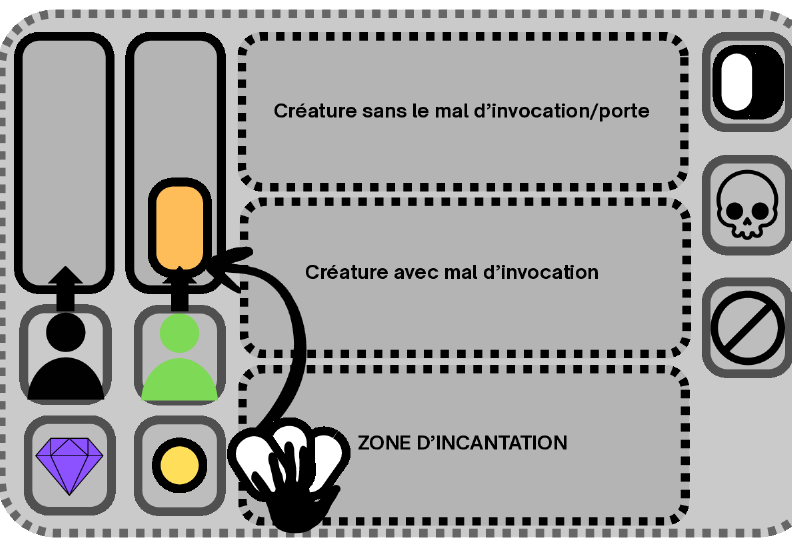
A Creature that has just been invoked cannot attack (Invocation Sickness), BUT it can block, use its actions once per turn unless otherwise stated, and use its effects.
Players keep taking turns until both Summoners of one player are dead.
Card types
The logo at the top of the card tells you when it can be played, whether it stays on the Battlefield and whether it Untilts at the beginning of your turn.

Level
Playable ONCE during your turn. Untilts at the beginning of your turn.

Creature
Playable during your turn, it stays on the Battlefield. Untilts at the beginning of your turn.

Imminent Creature
Playable during your turn as well as your opponent’s, it stays on the Battlefield. Untilts at the beginning of your turn.

Incantation
Playable during your turn, it stays on the Battlefield.

Imminent Incantation
Playable during your turn as well as your opponent’s, it stays on the Battlefield.

Door
Playable during your turn, it stays on the Battlefield. Does not Untilt at the beginning of your turn.

Door-Creature
Playable during your turn, it stays on the Battlefield. Untilts at the beginning of your turn.

Imminent Door
Playable during your turn as well as your opponent’s, it stays on the Battlefield. Does not Untilt at the beginning of your turn.

Imminent
Playable during your turn as well as your opponent’s, it goes to the Cemetery once resolved.
Play areas
The official playmat gathers all of one player’s zones. Each number matches one specific area:
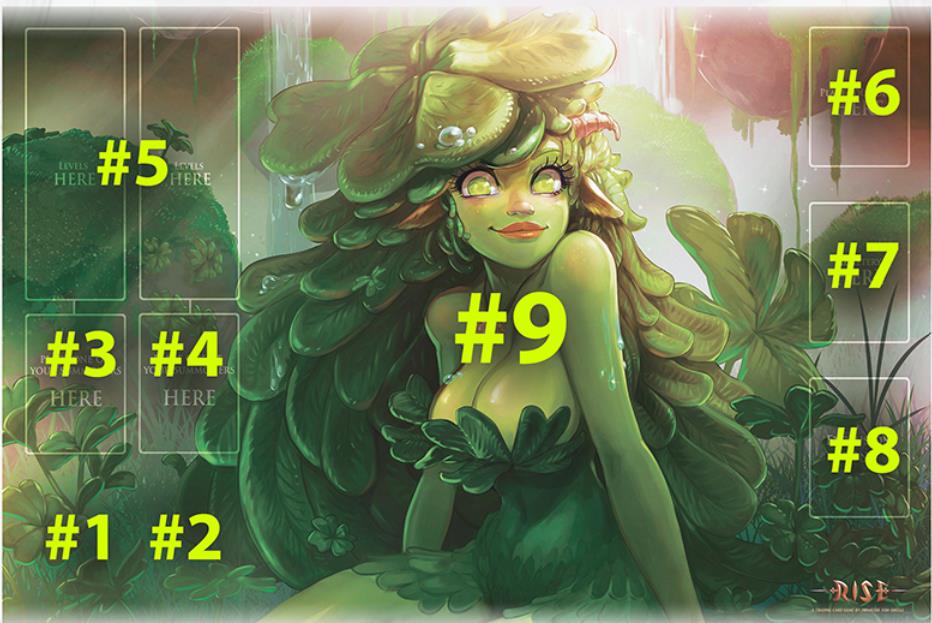
- Stock — your coins, 30 at most.
- Ether — your Ether reserve, 30 at most. When you have priority, you may spend 3 Ether to draw 1 card or gain 1 coin.
- Summoner — the slot of your first Summoner.
- Summoner — the slot of your second Summoner.
- Level Ups — the Level Up cards played on each of your Summoners — only one per turn.
- Library — your 50-card deck, face down.
- Cemetery — your discarded, sacrificed or destroyed cards, face up. Any player may look through it.
- Exclusion Zone — the cards excluded from the game, face up.
- Battlefield — all of your cards in play.
The hand — the cards you can invoke or discard. Only you can see them.
Combat
A combat opposes the Attack and Defense values of Creatures. A player may only block an attacking Creature with a single Creature (except with the « Horde » ability).
The Attacker deals its Attack value to the Blocker, and vice versa. Combat damage reduces Defense until the end of the turn: if a Creature’s Defense drops to 0 or below, it is Destroyed.
An attack of value 0 still hits its target, but deals 0 damage.
If an attack is not blocked, the attacked player chooses which of their Summoners takes the Attack value.
If an attacking Creature is Untilted before combat resolution, it is no longer considered an Attacker.
Priority and resolution
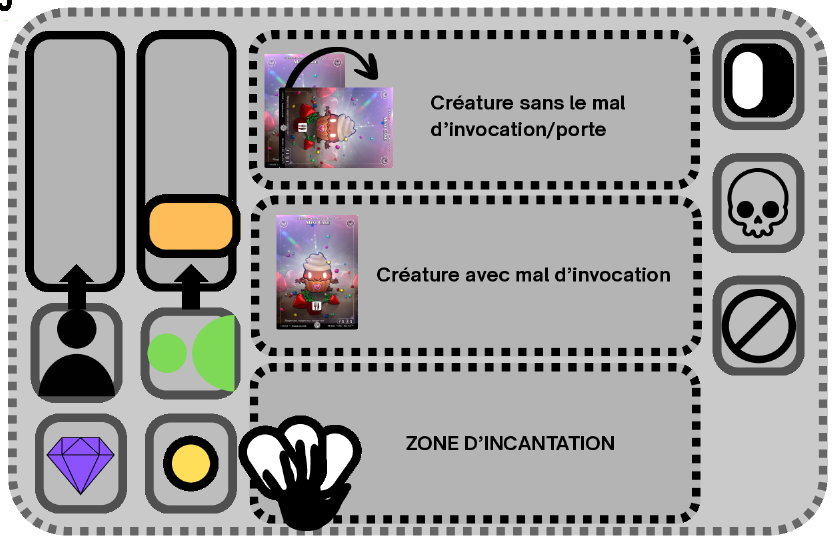
In Rise, almost everything can be responded to. Each series of lightning bolts in the rule book matches one of these four situations — responses pile up on the Stack, then everything resolves.

When: You activate a card effect, a Summoner skill or the action of a card you control.
Response: your opponent may invoke Imminent cards, activate actions or Summoner skills. If they do, you may respond in the same way, otherwise it resolves.

When: You play a new card, use a Summoner skill or activate the action of a card you control.
Response: your opponent may respond in the same way — Imminents, actions, Summoner skills — otherwise it resolves.

When: Your opponent plays an Imminent card, activates a Summoner skill or the action of a card they control.
Response: you may respond by invoking Imminents, actions or Summoner skills. If you do, they may respond in the same way, otherwise it resolves.

When: You respond by playing an Imminent card, a Summoner skill or the action of a card you control.
Response: your opponent may only respond with Imminent cards, actions or Summoner skills. If they do, you may respond again, otherwise it resolves.
Resolution: the elements of the Stack resolve one after the other, in the reverse order of their arrival — from the most recent to the oldest. During resolution, there is no more priority exchange between players.
The coin toss
Rise uses chance as a true game mechanic. Many Actions, Effects and Skills require a coin toss: the result is a « Success » or a « Failure » depending on the visible side after the toss.
Before the game starts, the players agree on which side of the coin counts as a Success.
A toss is required whenever a game element shows a resource icon surrounded by arrows — the possible outcomes are written after the icon.
The coin toss can be replaced by any process with two equally likely outcomes, such as a 6-sided die (even = Success, odd = Failure).
Passive abilities
Passive abilities require no action: they apply on their own. They are identified in blue on this page.

Adept
This card is also of the Adept type.

Assimilation
Before the Combat Phase, you may stack Creatures with « Assimilation »: the top Creature keeps its properties, but its Attack and Defense equal the sum of the stacked cards’ values.

Advantage
If this card would deal combat damage to a Summoner, its controller chooses which Summoner takes the Combat damage.

Bomb
This card is also of the Explosive type.

Candy
This card is also of the Candy type.

Constancy
This card cannot receive -X / -X Charges.

Distance
This card can only be blocked by a Creature with the « Distance » ability or a « Door » on the same ground or celestial plane. And via « Range ».

Drain
After the Combat Phase, if this Creature was blocked and survived, it gains a +1/+1 Charge.

Water
This card is also of the Water type.

Electric
This card is also of the Electric type.

Chained
No additional effect by itself — but some cards trigger when this ability is lost.

Rooting
This Creature can only be Destroyed by Combat damage, or Sacrificed.

Together
Invoking this card requires spending 2 invocation points, 1 from each Summoner. It cannot be Called.

Equipment
This card is bound to the card it equips while that card is in play. If the equipped card is returned to hand, sent to the Cemetery or Excluded, this card follows.

Explosion
Once during your Combat Phase, if this Creature is equipped with a « Bomb » card, Sacrifice it, then Destroy a targeted enemy Creature on the same plane.

Fire
This card is also of the Fire type.

Ice
This card is also of the Ice type.

Horde
When defending, this Creature may block an additional Creature as long as the combined Attack values of the Creatures already blocked stay below its Defense value.

Imitator
Once per turn, this card may Reactivate an Action from one of your cards as if it had the Action itself.

Immunity
This card cannot be infected by a disease.

Disease
The Effects of this card are diseases.

Morpher
When this card enters play, it copies the target stated in its « Morpher: » effect, keeping its type, the « Morpher » ability and the Action on its card.

Multi-target
An Action of this card can be Reactivated as many times as you can pay its cost, changing the target with each Reactivation. Its Actions are « Fixed price ».

Food
This card is also of the Food type.

Shadow
This Creature loses all of its other types, abilities, Actions and Effects: it becomes unblockable but cannot defend.

Wall-walker
This Creature cannot be defended against by a Door and cannot be affected by the Effect or Action of a Door.

Iron skin
When this Creature blocks, it gains a +1/+1 Charge after the Combat Phase.

Breakthrough
When this Attacker is blocked, it deals the defending player the difference between its Attack value and the Blocker’s Defense value.

Poison
Reserved for Food Creatures. At the beginning of their controller’s Invocation Phase, one of their Summoners loses 1 LP per poisoned card.

Range
This Creature may defend against all cards that are not unblockable.

Fixed price
The cost of this card’s Actions cannot be modified.

Riposte
When this card blocks during a combat, its base Attack value is doubled for the resolution of that combat.

Bleed
When this Creature is blocked and survives, the Creature that blocked it gains a -1/-1 Charge after the Combat Phase.

Splash
Each time this Creature deals combat damage to a Summoner, it deals the same amount of damage to the other Summoner.

Symbiosis
This card benefits from its « Symbiosis: » text.

Time out
The Effects and Actions of this card resolve considering the state of the game at their declaration, not at their resolution.

Velocity
This Creature may attack the turn it enters play, but its printed Attack then drops to 0. It can still benefit from +1/+1 Charges.

Lock
This card can be opened or closed via an effect.

Flight
This card is on the Celestial plane.
Active abilities
Active abilities require an activation, and most often resolve on a coin toss. They are identified in red on this page.

Cloning
Success: duplicate this Creature on your Battlefield. Failure: destroy this Creature. Only activatable during your turn and if this card is of the Clone type.

Diversion
Success: until the end of the turn, the targeted Creature cannot defend. Only activatable before the Combat Phase.

Dodge
Success: the enemy Creature deals no combat damage during this Combat Phase. A « Disease » card you control infects this enemy Creature. Activatable during the resolution of a combat involving this Creature.

Exhumation
Success: a targeted Creature you control gains a +1/+1 Charge. If the target is of the « Zombie » type, it gains a +2/+2 Charge instead. Activatable when this Creature is Destroyed.

Possession
Success: after the Combat Phase, even if this Creature is no longer on the Battlefield, take control of an enemy Creature that took part in this combat. Untilt it and place it on your Battlefield until its owner’s next turn. Only activatable when this Creature attacks or has blocked.

Rage
Success: this Creature gains a +1/+1 Charge. On Activation, you may toss an additional coin as long as you get Successes: this Creature gains a +1/+1 Charge per successful toss. Remove these Charges at the end of the turn.

Reanimation
Success: this card stays on the Battlefield and is Reset. It gains a +1/+1 Charge. If this card would be Destroyed again, Exclude it instead. Only activatable when this Creature is Destroyed.
Card pictograms
Cards use a set of pictograms to show values and conditions.
- Summoner : refers to a Summoner.
- Ether : the resource of the multiverse.
- Coin toss : this ability resolves with a coin toss.
- Action cost : the number of coins to spend.
- Life point : a Summoner’s LP.
- Solid square : constant effect.
- Tilde : effect.
- Solid circle : condition.
Glossary
Cycle and turn
A cycle corresponds to a number of turns equal to the number of players. It starts with one player and ends when their turn comes back. A turn is the game turn of a single player.
Game vocabulary
- Invoke — play a card from your hand by paying its cost.
- Call — put a card into play from another zone: Library, Cemetery, Exclusion Zone or outside the game.
- Constant — a card on the Battlefield that is not only of the Imminent type.
- Charge — a +X/+X or -X/-X marker placed on a card, modifying its Attack and Defense.
- Discard — send a card from your hand to your Cemetery. The discarding player chooses the card.
- Destroy — send a card to its owner’s Cemetery. An Infinite Rank card is removed from the game instead.
- Sacrifice — voluntarily destroy one of your cards: it is both Sacrificed and Destroyed.
- Exclude — send a card to its owner’s Exclusion Zone. Only Constant cards can be Excluded.
- Tilt / Untilt — turn a card 90° to mark its use, then return it to its initial position. Untilting a card does not reset it.
- Reset — return a card to its initial version.
Official documents
the documents are organized by level. Download the booklet that matches your profile: